This week I am presenting St. Therese de Lisieux to my class so since I don't need to journal on her I will post some pictures and a few YouTube videos!
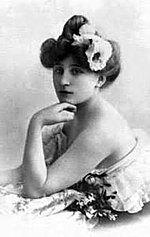
Sidonie-Gabrielle Colette was a prolific and acclaimed French writer of the early 20th century. She has been proclaimed one of France's greatest female authors with about fifty written works attributed to her. Colette was born in the Burgundy region of France in 1873. During her childhood, Colette played piano and did well in school. One of Colette's most well known works is her novel Gigi. Published in 1944, Gigi was adapted into film and even into a play and Broadway musical. Interestingly, Audrey Hepburn was chosen by Colette to play Gigi in the 1951 play adaptation.
In 1893, twenty year old Colette married her first husband Henry Gauthier-Villars, who was also a writer. Henry published his work under the pen name "Willy". The couple published the Claudine series together. Colette left her first husband in 1906 and went to live with her friend, and lover, Natalie Clifford Barney. Colette and the American expatriate salonist Natalie had a short lesbian affair and remained friends afterwards. During this time, Colette worked in the music halls where she worked with and became intimate with Mathilde de Morny, a fellow performer. In 1912, Colette was married for the second time. She and her husband had a daughter named Colette de Jouvenel. Sadly, Colette did not spend much time with her daughter. During World War I, Colette wrote a ballet for the Paris Opera. She also opened up her husband's estate to wounded soldiers. For her "hospital" she was awarded the Legion of Honor. In 1924, Colette divorced her husband after her affair with her stepson was discovered. She would marry again in 1935. Her third husband, Maurice Goudeket, wrote Colette's biography. Her post-war works include Gigi and Chéri, two of her most famous novels. Colette died in 1954. Her books were surprising because of their often intimate themes, but they were clever and people enjoyed reading them which is why she became such a well-loved French author.
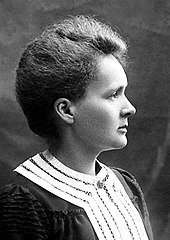
Marie Curie was an extremely important woman of science during the 19th century. Marie was born in Poland when it was under Russian occupation. Under Russian occupation, it was difficult for young Polish people to get an education that was not corrupted or influenced by the Russian regime. So, Marie had to begin her studies in Warsaw's secret underground university, often called the Floating or Flying University. The Flying University defied Russian occupation with its pro-Polish curriculum and its admittance of women in its classes. Marie and her family struggled monetarily through most of her early life. She took a position as a governess so that she could earn money to support her sister's studies in Paris. While earning money to pursue her own studies, Marie educated herself further by reading and writing letters.
In 1891, Marie moved to Paris to stay with her sister while studying at the University of Paris. Marie studied physics, chemistry, and mathematics. After earning one of her degrees, Marie began her career when she decided to investigate the magnetic properties of metals. She soon met her future husband, Pierre Curie, who was also a scientists and a teacher. They began working on various projects together and eventually fell in love and got married.
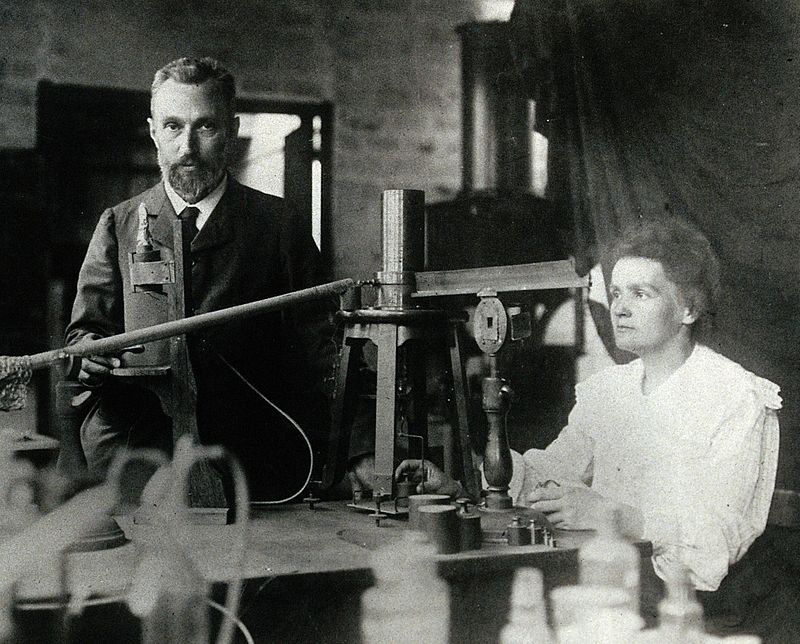
Pierre and Marie Curie
In 1895, X-rays were discovered by Wilhelm Roentegen and then in 1896 , Uranium was discovered to display X-ray like emissions. Marie was very interested in these studies and decided to work with uranium. One of her first uranium discoveries was that the element could conduct electricity in the air around it. This led to the important discovery that atoms are divisible from each other. This initial work with uranium led to further research on the radioactivity of different elements and minerals. Unfortunately, Marie and Pierre did not know about the risk they were taking by handling extremely radioactive elements without proper safety equipment.
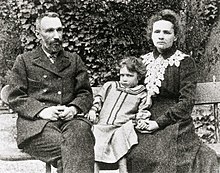
The Curie Family
In 1897, Marie and Pierre's daughter Irène was born. Marie got a position to teach at the École Normale Supérieure. Her job as a teacher helped support her family as well as her research. Marie and Pierre used a shed near the School of Physics and Chemistry as their laboratory. After making her discoveries, Marie quickly published her work, knowing that if she did not somebody else would get the credit for doing similar work by publishing their findings before her. In 1898, the Curie's published there discovery of polonium and radium, two radioactive elements, but it wasn't until 1910 that the Curie's successfully isolated pure radium. The couple published many papers on their work. One interesting paper was about how tumor-forming cancer cells, when exposed to radium, would die off faster than healthy cells. In 1903, Marie earned her doctorate and she and Pierre were invited to give a presentation in London about radioactivity. Unfortunately, because Marie was a woman she was not allowed to speak during the presentation, so Pierre had to do all the talking.
In 1903, Marie was awarded the Nobel Prize for physics for her research on radiation, making her the first woman to receive a Nobel Prize for her scientific work. The next year Marie and Pierre had a second daughter, Ève, but in 1906 Pierre died after being struck by a horse-drawn vehicle. After Pierre's death, the University of Paris granted Marie her husbands professorship position making her the first woman professor at that university. During World War I, Marie was involved in the Red Cross Radiology Service and helped provide mobile X-ray technology. After the war, she toured some parts of the world to raise funds for future radium research. Marie died in 1934 from aplastic anemia, a disease often caused by exposure to radiation. She and Pierre were interred in the Panthéon in Paris.
Flora Tristan was a French social and feminist activist in the early 19th century. Flora was born in Paris in 1803. Her father was a Spanish colonel and his family had a great deal of influence in Peru. Flora's father died when she was four years old, but due to legal technicalities, her deceased father's lands and wealth were confiscated leaving Flora and her mother destitute. Flora went to Peru in 1833 attempting to get her father's property back. Though she was unable to get back her rightful inheritance, Flora was certainly inspired by her stay in Peru. She wrote a travel diary about her time there and published it with the title Pérégrinations d'une Paria. Flora married a man named André Chazal in 1821. Their marriage was a failure and Flora felt that she was enslaved by marriage. She sought to separate from him, this separation was not granted until after her husband shot her. Her experience of marriage and her travels to Peru and other countries helped fuel her desire to write about social issues and to take an active role in trying to fix the problems in society. Her last work written in 1843, The Worker's Union, is a good example of her social and political activism. Flora connected the working class's struggles with the struggles of all women.
"In the life of the workers, woman is everything.
She is their providence. If she is missing, everything is missing."
-Flora Tristan
In 1844, Flora contracted yellow fever and died. There is an association for women in Peru named after Flora Tristan. It is called Centro de la mujer peruana Flora Tristán. They have a website written in Spanish, but I believe that they provide legal help to women who may be suffering from domestic violence. They also have an online library and their website can help direct those who wish to have an active role in social change get more information about what they can do to become involved.
Here are some links with more info on Flora Tristan!
Madame Roland was born in Paris in 1754. She was very well educated, studying literature, music, and dance. Roland had some schooling in a convent, where she was influenced by reading the work of Voltaire and Plutarch. In 1780, she married the philosopher Jean-Marie Roland de la Platière. This husband and wife team both became supporters of the French Revolution and were leaders of the Girondins. Interestingly, Madame Roland and her husband had first identified with the Jacobin Club before defecting and creating the Girondin party. Most of Roland's influence came from her "tweaking" of her husband's political letters and pamphlets. Roland also had a salon at the Hotel Brittanique in Paris. In 1793, during the Reign of Terror, Roland and other Girondins were arrested, their crime treason. During her imprisonment, Roland wrote her memoirs and had them smuggled out of prison by her visitors. Roland helped her husband escape Paris and was eventually guillotined in November 1793. Her memoirs were published posthumously, allowing Madame Roland to continue influencing the formation of the French Republic.
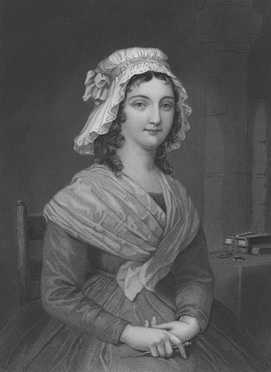
Marie-Anne Charlotte de Corday d'Armont was a female supporter of the Girondins party and an assassin. Charlotte was born in Normandy. Her parents were minor members of the aristocratic class. After her mother's death, her father sent his remaining children and Charlotte to an abbey, the Abbaye aux Dames, in Caen, Normandy. There Charlotte had access to the writings of Plutarch, Rousseau and Voltaire. Charlotte was educated at the Abbey and probably lived there until 1791 when she began living with her cousin Madame Le Coustellier de Bretteville-Gouville in Caen. Charlotte identified with the Girondin party, which was less radical and did not agree with the way the Revolution was evolving. Charlotte became very influenced by Girondin speakers and leaders. This influence would lead to Charlotte's plan to murder Jean-Paul Marat.
Marat was a journalist and major leader of the radical Jacobins, who implemented the Reign of Terror. Charlotte, at only 24 years old, left her home in Caen and traveled to Paris. She believed that Marat and his writings were influencing the people in a bad way and were contributing to the violence in the city and throughout the country. Charlotte rented a room and bought a kitchen knife. She wrote letters explaining her motives, Charlotte knew she was going to die for her actions and she accepted that her end would come from this plan. Initially, she had planned to kill Marat in public since she had heard that he often went to the National convention to attend meetings. She later discovered that he was at his home, suffering from a skin condition he had picked up while hiding in the Parisian sewers.
Charlotte went to Marat's home on the 13th of July, 1793. She asked to speak with him twice before being admitted in the evening. Marat was famously in his bathtub, soaking his putrifing sores. Charlotte had only been allowed to visit because she was going to give him the names of some of her Girondin friends. After telling Marat the names of her fellow Girondins, Charlotte stabbed him through his chest and straight through his heart with her kitchen knife. Charlotte was arrested and put on trial for the assassination of Marat. She testified that she alone had planned the murder. She was sentenced to die by the guillotine like so many other people during the Terror. On the 17th of July, Charlotte's hair was chopped off, she was loaded onto a tumbrel with several other people, and brought to the place of execution. Charlotte was probably wearing a red dress, symbolizing that she was being executed for murder. Charlotte was a heroine for willingly giving her life by ". . . [killing] one man to save a hundred thousand" from the Reign of Terror.
For more about Charlotte Corday click these links!
Olympe de Gouges was a playwright, feminist, and abolitionist during the French Revolution. Olympe was born Marie Gouze into a small bourgeois family. Her father was a butcher and her mother was the daughter of a cloth merchant. Olympe was convinced that she was the illegitimate daughter of a local nobleman, the Marquis de Pompigan, who had simply refused to acknowledge her. It is believed that this is why she often stood up for illegitimate children in her writings. In 1765, she married Louis Aubry, a man that she did not love. He died early in their marriage and eventually Marie moved to Paris with her young son and took the name Olympe De Gouges.
In Paris, Olympe gained access to some salons and had the opportunity to meet other writers and political figures. Olympe began her writing career in the 1780s. She was a very prolific writer with as many as forty works attributed to her writing. She wrote several plays such as Zamore and Mirza and L'Esclavage des Negres. Most of her work was about social issues, such as slavery and the rights of women. One of Olympe's most well known works is The Declaration of the Rights of Women and the Female Citizen. Olympe wrote her own women oriented Declaration in response to The Declaration of the Rights of Men and the Male Citizen. Olympe was eventually arrested after creating and posting a poster called The Three Urns or, Salvation of the Father Land by an Aerial Traveller. This poster upset the radical Jacobins who did not like that her poster asked its audience to pick one of three types of government. Olympe was arrested in 1793 and while imprisoned and on trial, she did not have the right to an attorney. Olympe defending herself against a jury of men who were all against her cause and the fact that she was a meddling women, was sentenced to die by the guillotine. Olympe had passionately joined in the revolutionary spirit, perhaps hoping that a regime change would be an appropriate time for women, and other people without the same rights as men, to join together and get the rights that they deserve. She was courageous and was not afraid to write and publish anything that might get her killed. She died for supporting and believing in her own words.
Click these links to learn more about Olympe de Gouges!